Four Windshield Wipers on a Minivan
I directed a generative video engine the way I'd direct a cinematographer. It turns out that's the wrong language, and I'm not sure I'm the one who needs to learn a new skill here.

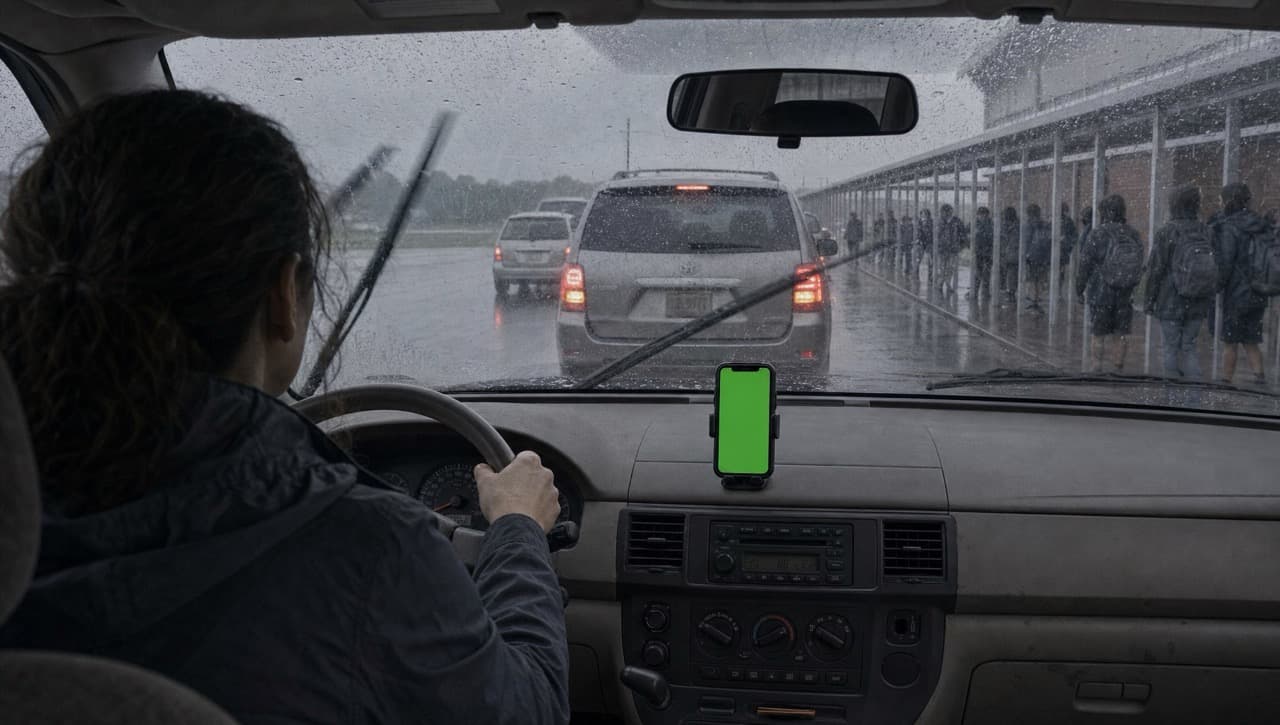
The van had too many windshield wipers.
Not one too many. Four blades across the glass of a minivan in a school pickup line, evenly spaced, all sweeping in time, in a shot that was otherwise good. The rain was right. The light was right — that flat gray you get an hour before a storm actually commits. Brake lights on wet asphalt. The kid in a pink raincoat, wet hair stuck to her face, doing exactly the thing I'd asked for.
And four wipers, delivered with complete confidence. No warning. No hedge. No "I wasn't confident about this part." Here is your van, sir.
I was making a :20 spot for SimpleSignal — a small app that turns your phone into a bright colored beacon so somebody can find you in a crowd. School pickup in the rain is the whole pitch in one scene with no dialogue: a hundred kids in the after-school pickup area, forty identical gray minivans, and a mother and daughter needing to connect. I did not need Pinewood Studios and ILM to create this scene. I needed a simple school pickup queue on a rainy day like any parent charged with this task can immediately identify with.
The "script" is less than a page long. All I had to do was prompt a collection of shots out of a generative AI engine. Heck, the company behind the engine was running a contest to make a commercial spot using their tools! Their "sizzle reels" showed stunning footage on par with Denis Villeneuve or Wieden & Kennedy's finest. My mundane school pickup line scene should be a piece of cake.
After several laborious hours explaining and re-explaining the premise above I had eked out 1.5 seconds of usable footage establishing the scene. Then...dead stop. I had burned through all 2,250 credits on my "Pro" plan and was in "time out" for a month.
If this was your set, would your Director of Photography keep his job? If you were the production company, would you send everyone home for a month to come back fresh?
These were the questions I was asking while seething mad.
Was it something I said?
Here's the part I keep re-hashing wondering what happened.
I didn't prompt it like a person poking at a toy. I prompted it like I was a director talking to my cinematographer, because that's the job I was doing and that's the language the job has. Thirty years of standing near shoots will do that to you — you stop describing what you want to see and start describing where to put the camera.
That vocabulary exists for a reason. Film is collaborative and it's expensive, so the trade built a compression protocol: a set of terms that let one person hand a shot to another person in six words without a diagram.
Don't cross the line. Camera left. She's screen right of the van, hold her. Push in, let the van go soft. Match the eyeline from the last setup.
Every one of those is short because both people already have the same set in their heads. The words aren't the instruction. The words represent a shared understanding of a spatial model that follows a common set of rules.
The engine parsed words and struggled to understand the set they described. I was having to invent new terms. Like having to call, "sky", "light blue colored blank space above the subject."
“The ships hung in the sky in much the same way that bricks don't.”Douglas Adams, The Hitchhiker's Guide to the Galaxy
So I'd say the van is to her left, and get the van on her right. Not occasionally — often enough that I stopped trusting the word left altogether and started describing the flat frame instead of the space. Which is backwards. The frame is the output. The space is the input. When you find yourself specifying the output, you've stopped directing and started retouching.
The 180-degree line went the same way. That rule is about a hundred years old and it's not aesthetic — it's structural. You pick an axis between two subjects and you keep the camera on one side of it, because the audience is quietly building a map of the room and the map is what lets them follow the scene without thinking about it. Cross the line and two people in conversation suddenly appear to be facing the same way. The audience doesn't say "you crossed the line." They just stop believing it.
The engine crossed it constantly. It had no map to violate. It wasn't breaking the rule; the rule wasn't a thing that could be broken, because there was no room and no axis and no audience-in-the-head to confuse. It was making pictures that resembled photographs of a school pickup line, one at a time, each one plausible on its own and none of them in the same building.
Same explanation as the wipers, by the way. The model knows a windshield has wipers. It doesn't know how many, because "how many" isn't a property of the picture — it's a property of the van. It never built a van. Wipers are a texture, and texture doesn't have a count.
Who screwed up?
I want to be careful here, because there are two flattering stories available and I don't believe either one.
Story one: the tool is bad. Easy, satisfying, and I don't think it's true. What it does, it does astonishingly well — I could not have produced that grade, that rain, that light, at that speed, at any point in my career, for any budget I've ever had. I believe their marketing department wouldn't fake the sizzle reels.
Story two: I have good instincts and I caught what a civilian would have shipped. Also flattering, also not really true. I didn't catch four wipers because I'm perceptive. I caught them because I've yet to see a car with four front wipers. Maybe something exotic and European has them, but we're talking Mom's boring minivan here in the States. That's not judgment. That's exposure. It's worth being precise about the difference, because exposure is something you can point at and account for, and judgment is something people just claim about themselves.
Truth be told, I still don't know whose failure this was.
I was applying the specific working language of filmmaking to an engine that was never built to receive it. That might be the engine's limit. It might equally be mine — maybe there's a way to say "she's screen right of the van" in whatever dialect this thing actually speaks, and I never found it, and someone who's never been on a set would have found it in an afternoon by describing the picture instead of the room.
Both of those are plausible to me. I've been at this long enough to know that "the tool doesn't understand me" and "I don't know how to ask" produce identical symptoms from the inside.
What I'm sure of is that there was a disconnect, and that it sat exactly where the trade vocabulary was supposed to do its work. The place where the compression was supposed to happen is the place where everything fell apart.
As of today — this means the Cinematographer's swipe card still gets them onto the lot tomorrow. The nerd from IT hasn't taken their parking spot...yet.
By the end I was neither directing nor writing prompts
I was drawing on the frames. I had become John Madden scribbling on the telestrator.
Orange box around the part of the shot to keep. Orange arrow at the row of cars. Green text, in my own handwriting, over the wrong half of the parking lot: Facing the wrong way. Get rid of them.
That's not direction. That's pointing. It's what you do when you and the other party don't share a language and there's a deadline — you give up on syntax and start indicating objects. It worked better than the prompts did, which tells you something, though I'm not sure it's flattering to either of us.
I don't think, "pretend you're a sportscaster" is the best way to endear your tool to a commercial director.
What 2,250 credits actually bought
Here's the economics nobody puts in the pricing page.
Every render costs the same whether you keep it or throw it out. Generation is cheap per second and enormously expensive per usable second, and the gap between those two numbers is the entire product. The Pro plan is priced against the first number. The work happens against the second.
The credits didn't go to the frames I kept. They went to the ones I killed. And killing them was the job — not the prompting, not the settings, not the seed. Deciding this one's wrong, and then saying why it's wrong specifically enough that the next attempt is different, is the whole cost center. The prompt is free and infinitely repeatable. The verdict isn't.
“Which means the bottleneck was never the tool or the budget. It was whether the person at the keyboard can tell.”
Spoiler alert: I could tell.
An inconvenient truth
If I'd never been near a set, I'd have gone with the four-wiper van.
It's a decent shot. The light is lovely. Nothing about it announces itself as broken unless you happen to know what a minivan is supposed to look like — and by the time somebody else notices, it's on a product page with my name attached to it.
That's what generative AI failure looks, tastes, smells and feels like, and it's not the part people warn you about. The warning isn't that the machine can't do it. Heck — that would SAVE you tokens. The machine can do it beautifully, confidently, and/or wrong; the warning is it'll never once tell you which of those three you got until the tokens are spent. It's like someone mixed dog food kibbles in a gumball machine.
I'm not going to inflate this. It's a twenty-second spot for a small app, and I still don't have it. But it's the cleanest example I've got of what state-of-the-art actually is in 2026: the generating is free, the catching is not, and the language we spent a century building to prompt the result doesn't register.
Four wipers. Straight face. Not even an "oops".
I'm not naming the platform. This isn't a review, and there seems to be plenty of fail to share with the whole class.
If you liked this story, go download and try SimpleSignal. It'll help your kid find you in the rain, and other scenarios. Just be sure you look in the kid's direction first.